
VELÁZQUEZ’S LAS MENINAS: PAINTING, PRESENCE, AND THE PROBLEM OF LOOKING
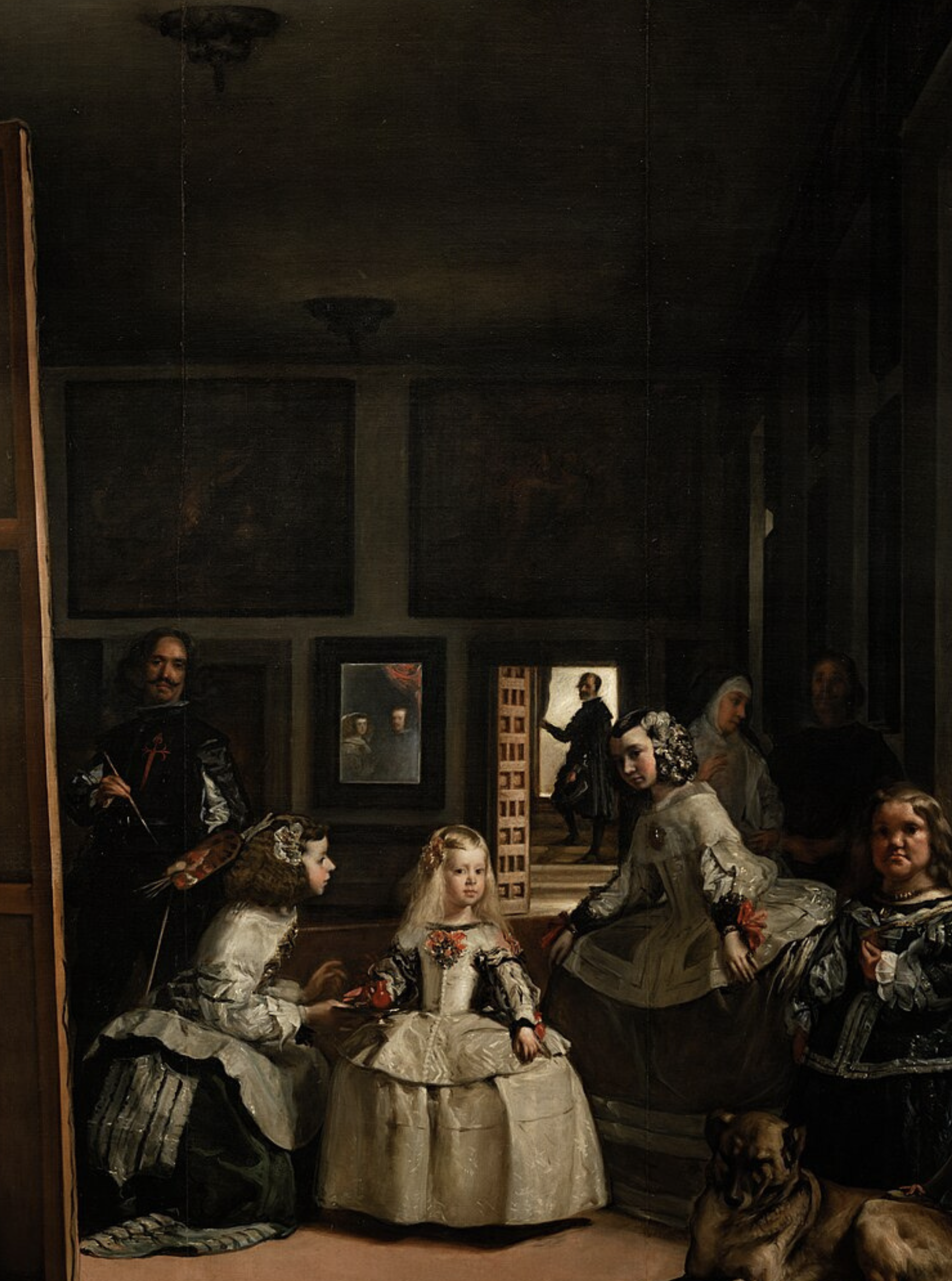
Few paintings have been looked at as much as Las Meninas, and yet it remains strangely unresolved. Painted in 1656 by Diego Velázquez, the work has been described, analysed, and interpreted endlessly, but it continues to resist a single, stable explanation. Its power lies precisely in that resistance.
At first glance, the scene appears simple enough: a group of figures gathered within a room of the Alcázar de Madrid. At the centre stands the young Infanta Margarita, surrounded by her attendants. To one side, Velázquez himself appears at his easel, paused mid-action. In the background, a mirror reflects the figures of the king and queen. A doorway opens into a distant space, where a figure stands caught between entering and leaving.
Everything is visible. And yet nothing is fully clear.
What makes Las Meninas so compelling is not only what it shows, but how it is constructed. Velázquez does not present a straightforward image. Instead, he builds a system of relationships—between figures, between spaces, and, crucially, between the painting and the viewer.
The artist is present within the work, but not as a distant observer. He looks outward, beyond the canvas, towards a space that appears to coincide with our own. This creates an immediate tension: are we looking at the painting, or are we being looked at?
The mirror at the back of the room complicates this further. It reflects the king and queen—Felipe IV de España and Mariana of Austria—who are not otherwise visible in the scene. Their presence is indirect, mediated through reflection. This raises a question that has no definitive answer: are they standing where we are, occupying the viewer’s position?
If so, the painting shifts entirely. The figures are no longer simply arranged within a composition; they are responding to something outside it. The painting becomes an event, not a static image.
Space, light, and control
Velázquez’s handling of space is remarkably precise. The room extends in depth, structured through subtle variations in light. The foreground is softly illuminated, drawing attention to the Infanta and her immediate surroundings. Beyond this, the light recedes, becoming cooler and more diffuse.
The open doorway at the back introduces another layer of depth. The figure standing there is neither fully inside nor outside the space. This ambiguity echoes throughout the painting. Boundaries exist, but they are never rigid.
Light plays a central role in maintaining this balance. It does not simply illuminate; it organises. It guides the viewer’s eye, establishing connections between figures and areas of the composition. Nothing is accidental. Every shift in tone contributes to the overall structure.
And yet, despite this control, the painting never feels rigid. There is a looseness in the brushwork, particularly in the treatment of fabrics and surfaces. From a distance, everything appears coherent. Up close, the image dissolves into marks, gestures, and fragments of colour.
The Infanta and the centre of attention
At the centre of the composition stands the Infanta Margarita. She is both the focal point of the painting and, in a sense, its most stable element. Around her, the other figures seem to orbit, each engaged in a slightly different action or state of attention.
Yet even here, certainty is limited. The Infanta is illuminated, presented clearly, and yet her role is not entirely fixed. Is she the subject of the painting? Or is she simply part of a larger arrangement that includes the unseen king and queen?
This ambiguity extends to the other figures. The maids of honour, the dwarf, the dog, the chaperone—each is rendered with care, yet none is fully central. Their presence contributes to the overall complexity of the scene without resolving it.
The artist within the painting
Velázquez includes himself in the composition, standing before a large canvas. This gesture is not merely self-referential. It alters the entire structure of the work.
By placing himself within the scene, he draws attention to the act of painting itself. The canvas he is working on is turned away from us, its surface hidden. We cannot see what he is painting. Instead, we see the conditions under which painting occurs: the space, the figures, the act of looking.
This is not a painting about a subject. It is a painting about representation.
Velázquez does not present himself as a craftsman, but as an intellectual figure—someone engaged in a complex process of observation and construction. This aligns with a broader shift in the status of artists during the period, as painting began to be understood not only as a manual skill, but as a form of thought.
The viewer’s position
One of the most remarkable aspects of Las Meninas is the role it assigns to the viewer. We are not placed at a safe distance, observing the scene from outside. Instead, we are drawn into it.
The direction of the gazes, the placement of the mirror, and the positioning of the artist all suggest that we occupy a specific place within the composition. We are not simply looking at the painting; we are part of the structure that makes it possible.
This creates a subtle but powerful shift. The painting does not exist independently of the viewer. It requires our presence to be completed.
An image that resists closure
Despite centuries of analysis, Las Meninas remains open. It does not resolve into a single interpretation, nor does it offer a clear narrative. Instead, it operates through a series of relationships that remain in tension.
This is what gives the painting its lasting power. It is not a problem to be solved, but a structure to be experienced.
Velázquez constructs a space in which looking itself becomes the subject. The act of seeing—of observing, reflecting, and interpreting—is placed at the centre of the work.
And in doing so, he creates something that feels unexpectedly modern.
Beyond its time
Although rooted in the court culture of seventeenth-century Spain, Las Meninas extends far beyond its historical context. Its concerns—about representation, perception, and the role of the viewer—continue to resonate.
It is a painting that does not close. It remains active, requiring each new viewer to engage with it anew.
Perhaps that is why it continues to hold attention. Not because it provides answers, but because it refuses to settle into certainty.
In front of it, one does not simply look.
One becomes aware of looking itself.